Jesu, Our Hope, Our Heart’s Desire ~


Jesu, our Hope, our heart’s Desire,
Thy work of grace we sing;
Redeemer of the world art Thou,
Its Maker and its King.

How vast the mercy and the love,
Which laid our sins on Thee,
And led Thee to a cruel death,
To set Thy people free!

But now the bonds of death are burst;
The ransom has been paid;
And Thou art on Thy Father’s throne,
In glorious robes arrayed.

O may Thy mighty love prevail
Our sinful souls to spare!
O may we stand around Thy throne,
And see Thy glory there!

Jesu, our only Joy be Thou,
As Thou our Prize wilt be;
In Thee be all our glory now
And through eternity.

All praise to Thee Who art gone up
Triumphantly to Heav’n;
All praise to God the Father’s Name
And Holy Ghost be given.

Words: Un­known au­thor, 7th or 8th Cen­tu­ry (Je­su nos­tra re­demp­tio, Amor et de­sid­er­i­um); trans­lat­ed from La­tin to Eng­lish by John Chand­ler (Hymns of the Prim­i­tive Church, 1837) and the com­pil­ers of Hymns An­cient and Mo­dern, 1861.

ht: cyberhymnal

Thursday Thirteen ~ Hebrews

Last Thursday Leslie at Lux Venit had thirteen hard sayings of Jesus in the book of Mathew. I wanted to follow her lead this Thursday. I’m wrapping up my reading of the book of Hebrews so here are 13 or more reasons to keep our eyes on Jesus and follow Him closely.


Hebrews 1:3 ~ “The Son is the radiance of God’s glory and the exact representation of his being, sustaining all things by his powerful word. After he had provided purification for sins, he sat down at the right hand of the Majesty in heaven.”

1 ~ God speaks to us through His Son.

2. ~ Jesus is the Heir of all things.

3. ~ Jesus is superior to all created beings.

4. ~ Jesus tasted death for everyone.

6. ~ Because Jesus has gone before us and prepared the way for us.

4. ~ So that we do not drift away.

7. ~ So that we do not become bitter.

8. ~ Jesus is the guarantee of a better covenant.

9. ~ Jesus always lives to intercede for those he saves completely.

10. ~ Jesus sacrificed himself for our sins.

11. ~ Through Jesus we can draw near to God.

12. ~ Jesus is the author and perfecter of our faith.

13. ~ When we fix our eyes on Jesus we will not grow weary and lose heart.

There are so many more reasons. Jesus is the same yesterday, today and forever.

This is a rich book that is filled with the supremacy and the completed work of Jesus. I pray that some of the deep truths in this book will stick in my heart and mind…

Jeremiah 31:33 ~ …”I will put my law in their minds and write it on their hearts. I will be their God and they will be my people.”

WFW ~ Hebrews 10: 19-23


“Therefore, brothers, since we have confidence to enter the Most Holy Place by the blood of Jesus by a new and living way opened for us through the curtain, that is his body, and since we have a great priest over the house of God, let us draw near to God with a sincere heart in full assurance of faith, having our hearts sprinkled to cleanse us from a guilty conscience and having our bodies washed with pure water. Let us hold unswervingly to the hope we profess, for he who promised is faithful.”

For more Word Filled Wednesday click here.

Eggs and Kulich

Our Easter preparations are on their way.

Katie colors the eggs each year.


I decorate the show piece of our food celebration, the Kulich (Russian Easter Bread). I did say decorate. I didn’t say I baked it. That is still on my list to do before I die.


We will celebrate all day tomorrow with friends, family, food, hallelujahs and hosannas to our Resurrected King.

Blessings on all your preparations and celebrations…

Photobucket is holding all my photos from 2007-2015 hostage. I’m working on updating my blog posts very slowly.

Legend of the Dogwood ~ Easter


~~~~

The Legend of the Dogwood

There is a legend, that at the time of the Crucifixion the dogwood had been the size of the oak and other forest trees. So firm and strong was the tree that it was chosen as the timber of the cross. To be used thus for such a cruel purpose greatly distressed the tree, and Jesus, nailed upon it, sensed this, and in His gentle pity for all sorrow and suffering said to it: “Because of your regret and pity for My suffering, never again shall the dogwood tree grow large enough to be used as a cross. Henceforth it shall be slender and bent and twisted and its blossoms shall be in the form of a cross. ..two long and two short petals. And in the center of the outer edge of each petal there will be nail prints, brown with rust and stained with red, and in the center of the flower will be a crown of thorns, and all who see it will remember.”

I recognize that this is just a legend but I wanted to post this entry because I’ve always loved the Dogwood blooms. If I look at them and think about what my Savior did for me that’s a good thing. He created the tree, the beautiful bloom, and you and me to enjoy it! Praising God this Easter season for His sacrifice on behalf of us.

Here are some interesting facts about the dates that Easter falls on;

Easter is always the 1st Sunday after the 1st full moon after the Spring Equinox. This dating of Easter is based on the lunar calendar that Hebrew people used to identify passover, which is why it moves around on our Roman Calendar.

Here’s the very full moon from last night 3-21-08 that caused Easter to be so early this year!

This year is the earliest Easter any of us will see for the rest of our lives! The next time Easter will be this early is in the year 2228 (220 years from now).

The earliest calendar date on which Easter can fall is March 22nd and the latest date it can fall is April 25th.

Next year in 2009 Easter will be on April 12th!

Happy Easter Everyone…

Poetry of the Cross

Over at Rebecca Writes there are links to posts with the theme of the Poetry of the Cross. This is something I found that I’ll contribute during this Holy Week.

I found this old book on our bookcase that Dear’s parents owned. It is called The Gospel in Art by Albert Edward Bailey copyright 1916.

I’m sharing this portion from the section RENI: “ECCE HOMO” John 19:1-5


Reni, Guido (1575-1642) Original: in the National Gallery, London.

“There is no denying that the thought of Christ’s suffering has been a powerful stimulus to the religious life of the past. Latin Christianity is full of it, and even Greek Christianity found inspiration in it. Hymns to the suffering Savior have sounded from many a monastery cell and have echoed sweetly down even to our own time. Take for example the wonderful hymn of Bernard, redolent of the midnight vigil and of modes of thought characteristic of his age, but of such beauty that every country and every Christian sect claims a share of it.

“O Sacred Head, now wounded,
With grief and shame weighed down;
Now scornfully surrounded
With thorn, thine only crown.
O Sacred Head, what glory,
What bliss till now was thine!
Yet though despised and gory
I joy to call thee mine.”

This hymn is one section of a long poem beginning “Salve mundi salutare,” addressed to the different members of Christ, “a most devout prayer of the Abbot St. Bernard, which he made when an image of the Savior with outstretched arms embraced him from the cross.” There is a still earlier hymn by Theoctistus of the Studium, Constantinople, less widely known but scarcely less beautiful in Neale’s translation. It is found in some of our hymnals under the first line, “Jesus, name all names above.” This hymn evidently arose under the same need as Bernard’s, and serves to show how all the harrowing details of suffering may be blended in thought with one’s highest spiritual good.

“Jesus, crowned with thorns for me,
Scourged for my transgression,
Witnessing in agony
That thy good confession.
Jesus clad in purple raiment,
For my evil making payment:
Let not all thy woe and pain,
Let not Calvary be in vain.”

When we visited the National Gallery we started in the religious art section with painting after painting of Christ on the cross. After a while I was eager to head to another part of the gallery. When I think of Jesus I do not typically picture Him on the cross at Calvary. I’m always eager to get from Good Friday (which my nephew thinks should not be called “good”) to Resurrection Sunday. I love to picture the Risen Christ, triumphant and victorious, after all that pain and agony. He Lives! Thanks be to God!

Photobucket is holding all my photos from 2007-2015 hostage. I’m working on updating my blog posts very slowly.

Maundy Thursday ~ John 13: 1-17

 I’m reposting this from last year… Blessings! 

Maundy ThursdayCeremonial washing of feet

Maundy Thursday is the Thursday of Holy Week (the Thursday before Easter). It was the day on which Jesus celebrated the Passover with his disciples, sharing a meal with them which we call the Last Supper.

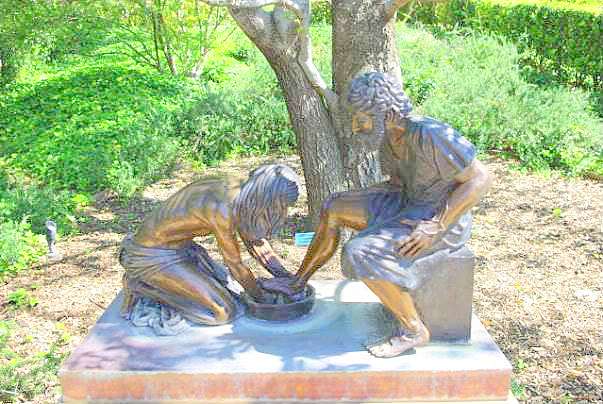
In those days it was usual for a servant to wash the guests feet on arrival. On this occasion there was no servant present and none of the disciples volunteered to do the menial task. Instead, Jesus got up and washed his disciples feet, giving them an object lesson in humility and service.

In some churches priests carry out a ceremonial washing of the feet of twelve men on Maundy Thursday as a commemoration of Christ’s act.

In Britain it is still customary for the sovereign to give ‘Maundy Money’ to a number of male and female pensioners – one man and one woman for each year of the sovereign’s age. The money is contained in two purses: one red and one white. The white purse contains specially minted coins – one for each year of the sovereign’s life. The red purse now also contains money, in lieu of gifts which used to be offered to the poor. Up to the time of James II the sovereign also washed the feet of selected poor men.

The word “Maundy” comes from the Latin for ‘command’ (mandatum). It refers to the command given by Jesus at the Last Supper, that his disciples should love one another.

Thanks to Jeff Osborne for supplying the picture below which shows a bowl with two platforms. The guest would be able to stand on these and have water poured over the feet into the bowl

 Ethiopian basin for washing feet

Jesus Washes the Disciples’ Feet ~  John 13: 1-17 (ESV)

13:1 Now before the Feast of the Passover, when Jesus knew that his hour had come to depart out of this world to the Father, having loved his own who were in the world, he loved them to the end. During supper, when the devil had already put it into the heart of Judas Iscariot, Simon’s son, to betray him, Jesus, knowing that the Father had given all things into his hands, and that he had come from God and was going back to God, rose from supper. He laid aside his outer garments, and taking a towel, tied it around his waist. Then he poured water into a basin and began to wash the disciples’ feet and to wipe them with the towel that was wrapped around him. He came to Simon Peter, who said to him, “Lord, do you wash my feet?” Jesus answered him, “What I am doing you do not understand now, but afterward you will understand.” Peter said to him, “You shall never wash my feet.” Jesus answered him, “If I do not wash you, you have no share with me.” Simon Peter said to him, “Lord, not my feet only but also my hands and my head!” 10 Jesus said to him, “The one who has bathed does not need to wash, except for his feet,  but is completely clean. And you  are clean, but not every one of you.” 11 For he knew who was to betray him; that was why he said, “Not all of you are clean.”

12 When he had washed their feet and put on his outer garments and resumed his place, he said to them, “Do you understand what I have done to you? 13 You call me Teacher and Lord, and you are right, for so I am. 14 If I then, your Lord and Teacher, have washed your feet, you also ought to wash one another’s feet. 15 For I have given you an example, that you also should do just as I have done to you. 16 Truly, truly, I say to you, a servant  is not greater than his master, nor is a messenger greater than the one who sent him. 17 If you know these things, blessed are you if you do them.

~~~~~~~

What Jesus did here to teach his disciples is very important for us to consider. He showed the “full extent of his love” by washing their feet and instructed them to follow his example and wash each others feet. We can’t miss the fact that serving one another is a very important truth that Jesus wants us to understand and follow. We need to put others needs above our own. Who does God want me to serve? Who am I suppose to wrap the towel around my waist for? Who am I suppose to lay down my rights and privileges for? Who am I to show the full extent of my love to?  Who am I suppose to humble myself for? I pray that I will go deep in understanding this amazing thing that God wants me to follow Him in and that you will, too. Let us consider together what our Savior, Master, King did and try to do the same.

http://www.gnpcb.org/esv/search/?q=John+13%3A+1-17

http://www.thisischurch.com/christianinfo/maundythursday.htm

WFW ~ Hebrews 12: 1-2


“Therefore, since we have so great a cloud of witnesses surrounding us, let us also lay aside every encumbrance and the sin that so easily entangles us, and let us run with endurance the race that is set before us, fixing our eyes on Jesus, the author and perfecter of faith, who for the joy set before Him endured the cross, despising the shame, and has sat down at the right hand of the throne of God.”

For more Word Filled Wednesday click here.

I is for Iona ~

It’s time for ABC Wednesday and this week we are on the letter I.

Come with me to the Isle of Iona in the Hebrides.

We traveled from the town of Oban on the western coast of Scotland by ferry to the Island of Mull and then we boarded a bus to travel down the Island to take a small ferry to the small Isle of Iona.

This little Isle is rich in history and beauty.

History of Iona

St. Columba, an Irish scholar, soldier, priest, and founder of monasteries, got into a small war over the possession of an illegally copied Psalm book. Victorious but sickened by the bloodshed, Columba left Ireland, vowing never to return. According to legend, the first bit of land out of sight of his homeland was Iona. He stopped here in 563 and established the abbey.

Columba’s monastic community flourished, and Iona became the center of Celtic Christianity. Iona missionaries spread the gospel through Scotland and North England, while scholarly monks established Iona as a center of art and learning. The Book of Kells – perhaps the finest piece of art from “Dark Ages” Europe – was probably made on Iona in the eighth century. The island was so important that it was the legendary burial place for ancient Scottish and even Scandinavian kings (including Shakespeare’s Macbeth).

Slowly the importance of Iona ebbed. Vikings massacred 68 monks in 806. Fearing more raids, the monks evacuated most of Iona’s treasures (including the Book of Kells, which is now in Dublin) to Ireland. Much later, with the Reformation, the abbey was abandoned, and most of its finely carved crosses were destroyed. In the 17th century, locals used the abbey only as a handy quarry for other building projects.

Iona’s population peaked at about 500 in the 1830’s. In the 1840’s a potato famine hit. In the 1850’s a third of the islanders emigrated to Canada and Australia. By 1900 the population was down to 210, and today it’s only around 100.

But in our generation a new religious community has given the abbey new life. The Iona community is an ecumenical gathering of men and women who seek new ways of living the Gospel in today’s world, with focus on worship, peace, and justice issues, and reconciliation.

The island is car free. While the present  abbey, nunnery, and graveyard go back to the 13th century, much of what you see today was rebuilt in the 19th century.

ht: history and other information taken from Rick Steves’ Great Britain

For more ABC Wednesday go see Mrs. Nesbitt.