Solzhenitsyn: A Pictorial Record, 1974


How easy it is for me to live with you, Lord!

How easy it is for me to believe in you!

When my mind is distraught and my reason fails,

When the cleverest people do not see further than this evening what must be done tomorrow

You grant me the clear confidence

that you exist, and that you will take care

that not all the ways of goodness are stopped.

At the height of earthly fame I gaze with wonder at

that path through hopelessness –

to this point from which even I have been able

to convey to men some reflection of the Light

which comes from you.

And you will enable me to go on doing

as much as needs to be done.

 ~ALEXANDER SOLZHENITSYN

http://newsimg.bbc.co.uk/media/images/38535000/jpg/_38535745_solzhenitsyn_ap_238.jpg

Summer Reading Challenge 2007

Here are my list of books for the Summer Reading Challenge…better late than never. Still completing my Spring challenge books. So for the summer…

Harry Potter and the Deathly Hallows and these….

Hood by Stephen Lawhead

Ancient Christian Devotional (year long)

Linnets and Valerians by Goudge

The little White Horse by Goudge

The Nine Tailors by Dorothy Sayers

Have His Carcase by Dorothy Sayers

The Documents in the Case by Dorothy Sayers

Knowing Scripture by R.C. Sproul

Stepping Heavenward by Prentiss

Future Grace by John Piper

I’m also in the midst of my daily Bible reading. I’m reading every book 20 times starting with the shorter books in the New Testament. I’m on I Timothy right now and I’ll move to Philippians next. By the end of the summer I might have 3 more books of the Bible completed…

I might also add any good books I find at Goodwill during the summer…:)

Pride and Prejudice by Jane Austen

I hope to join the fun at Seasonal Soundings….

Letters to Malcolm: Chiefly on Prayer, C.S. Lewis ~ Quote

If we were perfected, prayer would not be a duty, it would be delight. Some day, please God, it will be. The same is true of many other behaviours which now appear as duties. If I loved my neighbor as myself, most of the actions which are now my moral duty would flow out of me as spontaneously as song from a lark or fragrance from a flower. Why is this not so yet? Well, we know, don’t we? Aristotle has taught us that delight is the “bloom” on an unimpeded activity. But the very activities for which we were created are, while we live on earth, variously impeded: by evil in ourselves or in others. Not to practise them is to abandon our humanity. To practise them spontaneously and delightfully is not yet possible. The situation creates the category of duty, the whole specifically moral realm.

It exists to be transcended. Here is the paradox of Christianity. As practical imperatives for here and now the two great commandments have to be translated “Behave as if you loved God and man.” For no man can love because he is told to. Yet obedience on this practical level is not really obedience at all. And if a man really loved God and man, once again this would hardly be obedience; for if he did, he would be unable to help it. Thus the command really says to us, “Ye must be born again.” Till then, we have duty, morality, the Law. A schoolmaster, as St Paul says, to bring us to Christ. We must expect no more of it than of a schoolmaster; we must allow it no less…

But the school-days, please God, are numbered. There is no morality in heaven. The angels never knew (from within) the meaning of the word ought, and the blessed dead have long since gladly forgotten it. This is why Dante’s Heaven is so right, and Milton’s, with its military discipline so silly.

…In the perfect and eternal world the Law will vanish. But the results of having lived faithfully under it will not.

I am therefore not really deeply worried by the fact prayer is at present a duty, and even an irksome one.

BBC ~ Jane Austen, Elizabeth Gaskell, George Eliot

   O.K. this is kind-of cheating on the Works For Me Wednesday theme but here’s my tip for summer boredom. This tip is for the Moms…Send your kids off to grandma’s (that will help their boredom) then get your flannels on, brew a pot of tea and settle in the comfy chair and choose one of these BBC productions to escape to a quieter, gentler time… (if you have a 16 year or older daughter have her escape with you)

My daughter and I love BBC videos. I found some at a good price and couldn’t resist adding them to our viewing library. These are more typically DVD’s that we will watch over and over again so our money was well invested (in our minds anyway). I’m including a little review of the ones we’ve seen to give you an idea as to whether you might enjoy them. We like the detailed slow plot development that these longer series afford.

 Pride and Prejudice ~ Jane Austen

 Hands down our favorite. Well worth the 5 hour viewing time. This A & E version is a must have. We love this Elizabeth Bennet character Jennifer Ehle over the well acted Kiera Knightley in the new shorter version.

Wives and Daughters ~ Elizabeth Gaskell

Our charming Scottish Cinderella is just as likable as her stepmother is unlikeable in this gossip riddled tale set in the 1800’s. We’d watch this one again, not because of the gossip but the way that the heroine gracefully copes with it and her impossible stepmother.

North & South ~ Elizabeth Gaskill

Takes on the same sorts of class divide issues as Jane Austen but in the English industrial era. It may take a long time to develop but it’s worth the wait.

Persuasion ~ Jane Austen

One of Jane Austen’s later novels with a heroine that combines some of the lovable qualities of Elinor Dashwood and Jane and Elizabeth Bennett.

Mansfield Park ~ Jane Austen

Jane Austen’s most unlikeable heroine, Fanny Price, proves that the meek will inherit the earth by triumphing over the superficiality and virtue-lessness of her relatives and their friends.

Middlemarch ~ George Eliot

In this 19th century George Eliot story the plot is slow to develop and full of unlikeable characters. When the decent characters finally get their reward you don’t care anymore. Tedious but informative about some period customs and practices.

Berkeley Square

There are ten 52 minute episodes in this series that we haven’t had a chance to watch yet. It is described as a warm-hearted family drama set in turn-of-the-century-London, where three young girls come together as nannies and grow to be friends.

Dorothy Sayers Mysteries ~ Gaudy Night ~ Have His Carcase ~ Strong Poison

Dear and I are reading some of the Sayers mysteries and are looking forward to watching these three soon. These are described as three elegant murder mysteries adapted from the crime novels of Dorothy L. Sayers. Set in the 1930’s the relationship of amateur sleuth Lord Peter Wimsey and Harriet Vane unfolds in a realm of romance and intrigue. Dear and I just watched Strong Poison the first in this series. It’s presented as a serial not a movie. It was prepared for T.V. so it’s 3 one hour long episodes on one dvd.  We really enjoyed it. We like the development of the characters as much if not more than the mystery…

 Now if you’d like more tips about how to beat the summer boredom for your kids go over to Rocks in My Dryer.

The Four Loves ~ C.S. Lewis ~ Quote


 This quote is from The Four Loves by C.S. Lewis. My friend Jan sent it to Jody and I as it describes what happens in close friendships between 3 or more people. I love this quote and I hope it will augment your idea of friendship. I chose this book to illustrate this quote because the 3 friends Lewis speaks of are pictured on the cover.

Lamb says somewhere that if, of three friends (A, B, and C), A should die, then B loses not only A but “A’s part in C,” while C loses not only A but “A’s part in B.” In each of my friends there is something that only some other friend can fully bring out. By myself I am not large enough to call the whole man into activity; I want other lights than my own to show all his facets. Now that Charles is dead, I shall never again see Ronald’s reaction to a specifically Caroline joke. Far from having more of Ronald, having him “to myself” now that Charles is away, I have less of Ronald. Hence true Friendship is the least jealous of loves. Two friends delight to be joined by a third, and three by a fourth, if only the newcomer is qualified to become a real friend. They can then say, as the blessed souls say in Dante, “Here comes one who will augment our loves.” For in this love “to divide is not to take away.” Of course the scarcity of kindred souls – not to mention practical considerations about the size of rooms and the audibility of voices – set limits to the enlargement of the circle; but within those limits we possess each friend not less but more as the number of those with whom we share him increases. In this, Friendship exhibits a glorious “nearness by resemblance” to Heaven itself where the very multitude of the blessed (which no man can number) increases the fruition which each has of God. For every soul, seeing Him in her own way, doubtless communicates that unique vision to all the rest. That, says an old author, is why the Seraphim in Isaiah’s vision are crying “Holy, Holy, Holy” to one another (Isaiah VI, 3) The more we thus share the Heavenly Bread between us, the more we shall all have.”

http://www.tolkienlibrary.com/reviews/images/Inklings2.jpg

The Redwall Cookbook ~ Brian Jacques

If your young readers haven’t been introduced to the Redwall Series by Brian Jacques I recommend these books. I’m an adult who loves reading them. Good animals, evil animals, Redwall Abbey, feasts, adventures, what’s not to enjoy. I received The Redwall Cookbook for Christmas and wanted to share a Spring poem from the book. I’ll probably share a recipe from the book in the future. I thought of Rebecca’s backyard when I read this poem, since just this week all the snow melted away.

Spring

Here’s a secret you don’t know,
’twas a day or two ago
when rain washed winter’s snow away.
I heard two mousewives say,
I think the spring will soon be here,
oh my word, oh joy, oh dear!
The ice upon the pond is gone,
and see that bird, the chirpy one?
I tell you, ’tis no jest,
she’s built herself a nest.
Oh well, I never, gracious me!
Pray, what else do you see?
Why, bluebells, crocus, daffodils,
sprouting up ‘twixt vale and hills,
and grass upon the lea I’ve seen,
like gentle mist of green.
‘Tis not like me to gossip, dear,
but this is what I hear ~
Out in the woods, I tell you true,
I’ve heard the first cuckoo!
Cuckoo he cried, now spring is born,
look forward to each shining morn.
So hurry, ladies ~ haste indoors,
for your spring cleaning chores!

Enjoy the rest of Spring. Praise God for the bluebells, crocus, daffodils, and the cuckoos!

Britain with Lewis, Tolkien, Austen and (Monty Python!)

For our daughter Katie’s high school graduation in 2004, “Dear” and I took her to Great Britain. Katie is a reader, a learner, a writer, a poet and an artist. We asked her what she’d want to see and she came up with the brilliant idea of following some of her favorites around the Isle! The following is a photo log of our trip that we can highly recommend to all lovers of Hobbits, Inklings, Literary Giants, 19th Century England, Harry Potter, and wacky Holy Grail enthusiasts!

The Eagle and Child (The Bird and Baby) Oxford

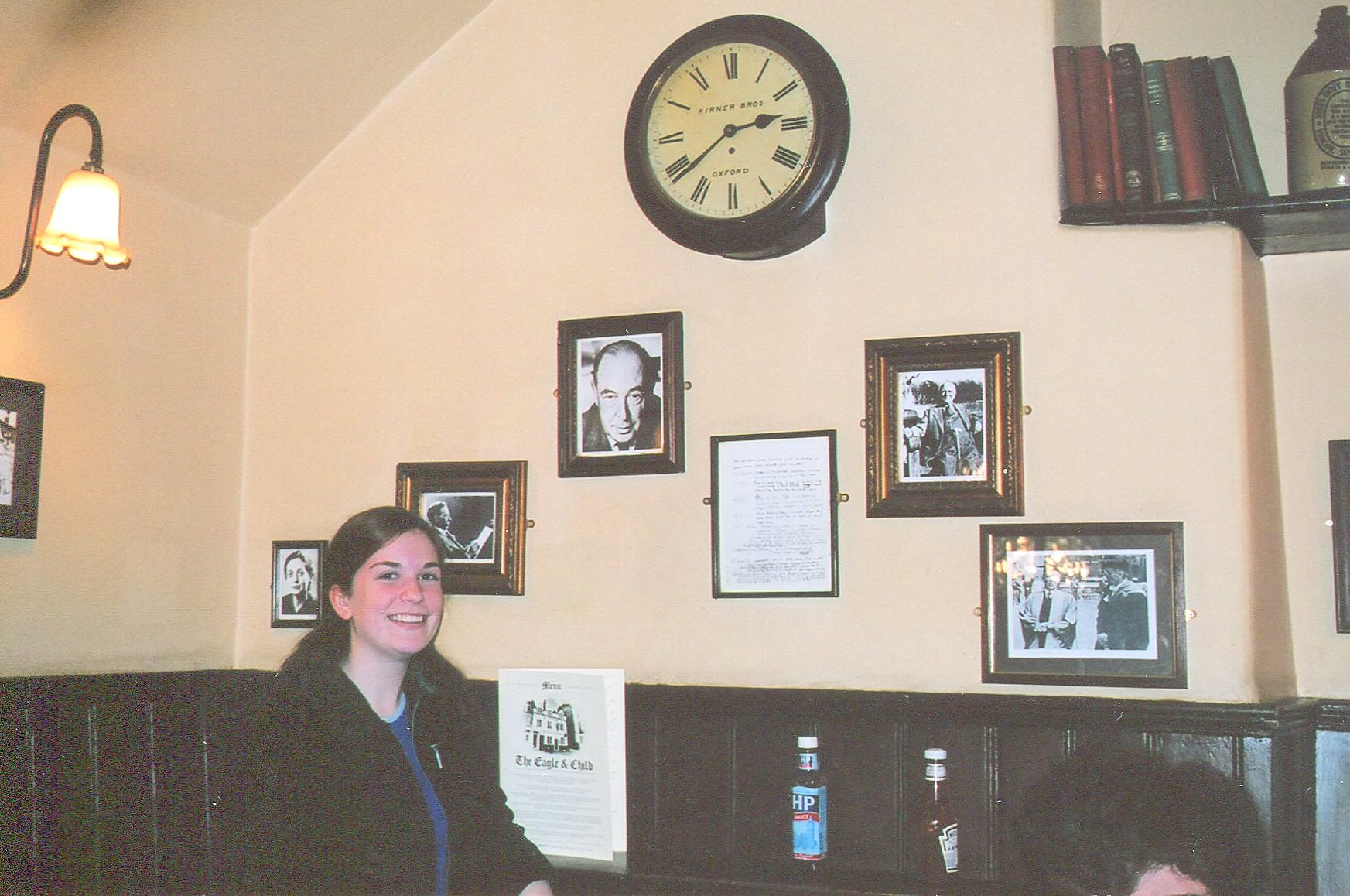
We set out from our first B & B base in Cheltenham to tour Oxford. Our first stop was The Eagle and Child (The Bird and the Baby) where the Inklings would meet and discuss their current writings, thoughts, etc.

The pictures on the wall are of C. S. Lewis, Tolkien, and other Inklings, plus letters, etc. We had a bite to eat and a pint was raised to toast our respected authors! “It comes in pints?”

Addison’s Walk

“Dear” and Katie on Addison’s Walk. This is on the grounds of Magdalan College (pronounced Maudlin) where Tolkien and Lewis would walk and have long conversations, after which C. S. Lewis was converted to Christianity. We found it, walked it and reflected on the beauty and wonder of it all!

Tolkien lived at 21 Merton St. after his wife died in 1971.

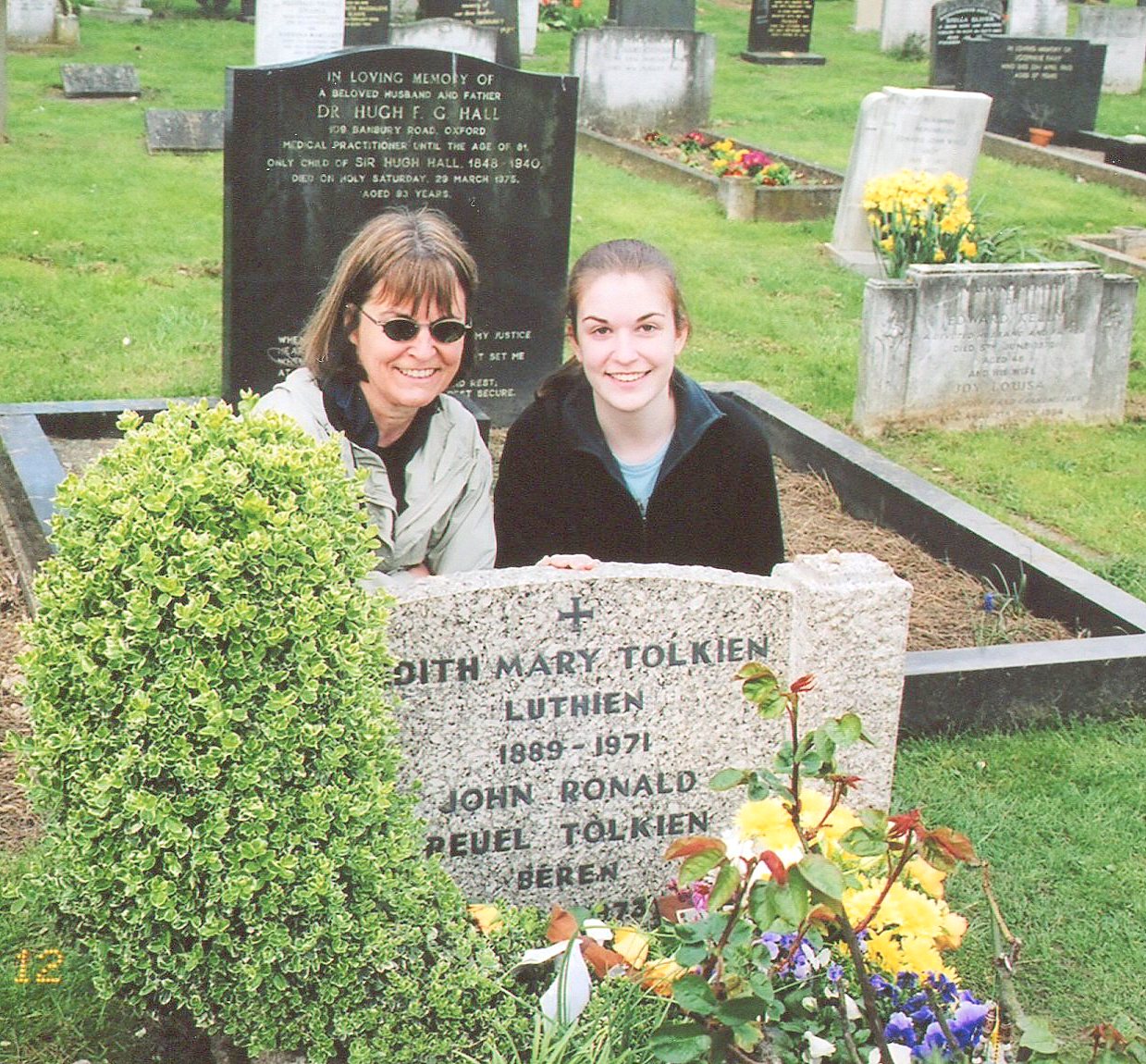
Katie would not let us leave Oxford till we found Tolkien’s grave. This was no small feat! Here we are at Wolvercote Cemetery in North Oxford at the graveside where he and his wife are buried. His son is buried here, also.  Katie left a note in Elvish, (yes, she learned to write and speak Tolkien’s Elvish).

EDITH MARY TOLKIEN
LUTHIEN
1889 – 1971
JOHN RONALD
REUEL TOLKIEN
BEREN
1892 – 1973

Buckley

Our next excursion took us in search of Hobbits in the Cotswolds. This is the little village of Buckley. While in the Cotswolds we also visited the Hidcote Garden which we highly recommend. We were here in April so gardens were not in their prime. If you get a Heritage pass this garden is part of the deal along with some of the castles and other sights we visited.

Hidcote Manor Garden

We next concentrated on Jane Austen. Our first excursion on this theme took us to Bath. We walked around the city finding the places she stayed and where some of the social gatherings happened in her books. Our prior research and guidebooks explained where these sights were. We imagined being at a dance or performance in these grand halls. We toured the Roman baths, Bath Abbey, and Number One on the Royal Crescent where Austen lived while in Bath. Two of her novels are set in Bath. On a side trip we visited Gloucester Cathedral where parts of Harry Potter movies were filmed.

Jane Austen Center, Bath

We left our first B & B in Cheltenham and headed Northeast to our second B & B in Sheffield. Although Sheffield wasn’t a comfy, cozy, little town it gave us good access to continue following Austen haunts. (I’d definitely pick some place more quaint to stay the next time we tour this area). The photo below is of Chatsworth House. The house Jane Austen based Darcy’s family home after. The new Pride and Prejudice movie actually filmed segments here. We were here in 2004 before the new film.  The estate was quite breathtaking. The small village of Bakewell close by was very reminiscent of  Lambton where Jane and her Aunt and Uncle stayed in Derbyshire.

Chatsworth House (Pemberley House)

“Every disposition of the ground was good; and Elizabeth looked on the whole scene — the river, the trees scattered on its banks, and the winding of the valley, as far as she could trace it — with delight.”

Bakewell (Lambton)

From Sheffield we continued North and a little East to the wonderful walled city of York. We dropped our rental car off here because you do not need a car in this compact city and from here we were taking a train to Edinburgh. We had the coolest walking tour book of this city and we were able to see a lot of things we would have missed without it. York Minster is a beautiful  Gothic Cathedral and we would recommend attending Evensong there.

From York we traveled by train north to Edinburgh. We arrived in Edinburgh found our self catering flat we rented and toured Edinburgh Castle and as much of Edinburgh our tired bodies could endure. We ate at a nice pub where Katie says she had the best hamburger she’s ever eaten.

Edinburgh Castle

 Our main side trip from Edinburgh was by bus to Stirling with a connecting bus to the little town of Doune where you’ll find Castle Doune. Castle Doune is the sight of some of the filming of Monty Python and the Holy Grail. This was a must stop for our daughter Katie. We were the only people at the castle (it was part of our Heritage Pass). To those of you who are familiar with this film you are handed coconut shells to walk around the grounds with. We were throwing out lines from the movie (Run Away, run away!) and making horse clip clop noises (with the coconut shells). They even take a picture of you here and post it on the official web page for Castle Doune and Monty Python and the Holy Grail. Hilarious fun. Back in Edinburgh we were given bad directions to the Elephant Cafe and never found it. So our Harry Potter sightings had to be confined to the outside of Bodleian Library (Oxford) and the outside of Gloucester Cathedral (Gloucester) where filming took place.

Castle Doune

From Edinburgh we took a train straight to London. We were finishing our trip here with so much to see. We walked our feet off. We went to the National Gallery, Westminster Abbey, St. Paul’s Cathedral, The Tower of London (photo), and so much more. We were here for the Queen’s 80th birthday and got to hear and see the cannons speak 80 times! One of my favorite sites in London is the British Library and their Greatest Treasures Room. You’ll see the Gutenberg Bible, Magna Carta, many incredible Sacred Texts, Literary Manuscripts by Austen, Bronte’, Chaucer, etc. Music on loan from the Beatles.  A must see when you’re in London. We included a trip to the theater to see Les Miserables. London was a wonderful culmination to a great tour of Great Britain.

The Tower of London and Tower Bridge

Here’s the main contributor and researcher for our marvelous literary tour of Great Britain.

Katie, our Seattle Girl.

Spring Reading Challenge


I’m joining the fray over at Callapidder Days  for the Spring Reading Challenge. Here’s my list of books I’d like to read/re-read.

Clouds of Witness  by Dorothy L. Sayers,  “One of the greatest mystery story writers of this century.”-L.A. Times   

The Screwtape Letters  by C.S. Lewis,   “My dear Wormwood,…”

The Treasure Principle  by Randy Alcorn,  “This book is about the joy of giving”

When People are Big and God is Small by Edward T. Welch,   (Overcoming Peer Pressure, Codependency, and the Fear of Man)

Byzantium by Stephen Lawhead,  An Irish Monk, Aidan, accompanies a gift, the Book of Kells to Byzantium. (Fantasy)

Oops! I forgot I’ll need to read Harry Potter and the Half Blood Prince by J.K. Rowling so I’m ready for book #7.

Just for the record I’m finishing Practical Christianity by William Wilberforce, and Living the Cross Centered Life by C.J. Mahaney before I move on to the rest.

Update: You can find my book reviews here;

https://happywonderer.wordpress.com/2007/04/04/spring-reading-challenge-book-reviews/

https://happywonderer.wordpress.com/2007/04/11/spring-reading-challenge-book-reviews-2/

https://happywonderer.wordpress.com/2007/05/08/book-reviews-byzantium-and-the-treasure-principle/

Let the reading continue!   LNB

Nothing New Under the Sun

The more you read, especially the Bible, the more you find out that phrases and concepts that seem new really go way back to another time or another author. Take the following quote from Tolkien’s, The Lord of the Rings, that “dear” just read to me:

“Ever he would search and would question us above all else concerning the Great Battle that was fought upon Dagorlad in the beginning of Gondor, when He whom we do not name was overthrown.”

Does that ring a bell my fellow Harry Potter fans?

Two other phrases that are in the Bible and used in recent movies, songs, etc.

In 1 Samuel 14:7 Jonathon’s armor-bearer says “Go ahead; I am with you heart and soul.” Are any of you singing a tune after reading that. (I think I’m dating myself here)

“Mene, Mene, Tekel, Parsin” ” Tekel, you have been weighed in the balances and found wanting;” Daniel 5:27

This phrase was used in the movie “A Knight’s Tale”

Any others you can think of?

Blessings, LNB

Ides of March

The ominous warning, “Beware the Ides of March,” originated with the Roman ruler, Julius Caesar, who was assassinated on the Ides of March – March 15, 44 B.C. If you’ve heard the ominous warning, then it’s most likely due to William Shakespeare and his play, Julius Caesar.

The warning itself was made famous in Shakespeare’s play on Julius Caesar, when an unidentified soothsayer tells Caesar, who is on his way to the Senate (and his death), “Beware the ides of March.” Caesar replies, “He is a dreamer; let us leave him. Pass.”

The Astrologer Spurinna

According to historical writer C.J.S. Thompson, Ph.D. in The Mystery and Romance of Astrology, 1929, the unidentified soothsayer from Shakespeare’s play was a Roman astrologer by the name of Spurinna. According to Thompson – and confirmed in Plutarch’s account of the story written in 75 A.D. and Suetonius in 110 A.D. – it was sometime prior to the fateful day of March 15 that Spurinna had first given Caesar the famous warning to “beware of the Ides of March.”The astrologer, Spurinna, had previously warned Caesar that on “the Ides of March,” he would be in great danger. If, however, Julius Caesar took care on that one day – then all would be well.

According to Plutarch’s account, Caesar had previously made the wise decision to stay within the safety of his bedroom chambers on the 15th of March. However, Caesar’s “friend” Decimus (Albinus) Brutus (not Marcus Brutus) managed to convince him that the astrologer’s warnings were nothing more than superstitious foolishness.

So Julius Caesar decided to attend the Senate on the 15th of March. On his way to the Senate, Caesar “accidentally” met up with the astrologer. Upon seeing Spurinna, Caesar confidently informed the astrologer: “The Ides of March are come.”

Spurinna replied, “Yes, they are come, but they are not past.”

Later that day – on March 15, 44 B.C. – Caesar’s enemies assassinated him in the Pompey theater, at the foot of Pompey’s statue, where the Roman Senate was meeting that day in the temple of Venus.

What Are the Ides?

In the ancient Roman calendar, each of the 12 months of the year had an “ides.” In March, May, July and October, the “ides” fell on the 15th day. In every other month, the “ides” fell on the 13th. The word “ides” was derived from the Latin “to divide.” The “ides” were originally meant to mark the full moon – but since the solar calendar months and lunar months were of different lengths, the “ides” quickly lost their original intent and purpose. So an alternative (albeit somewhat dubious) theory, as to why Caesar might have “seemingly” ignored the ominous warning of Spurinna, is that perhaps Julius Caesar got the dates of the warning mixed up. He may have been thinking that the Ides of March fell on the 13th.

Using this theory, forgetful Caesar would have been very careful and stayed home on the 13th of March, but on the 15th of March his guard was down

ht:   http://astrology.about.com/od/oddstrange/aidesmarch.htm