Kulich – Russian Easter Bread

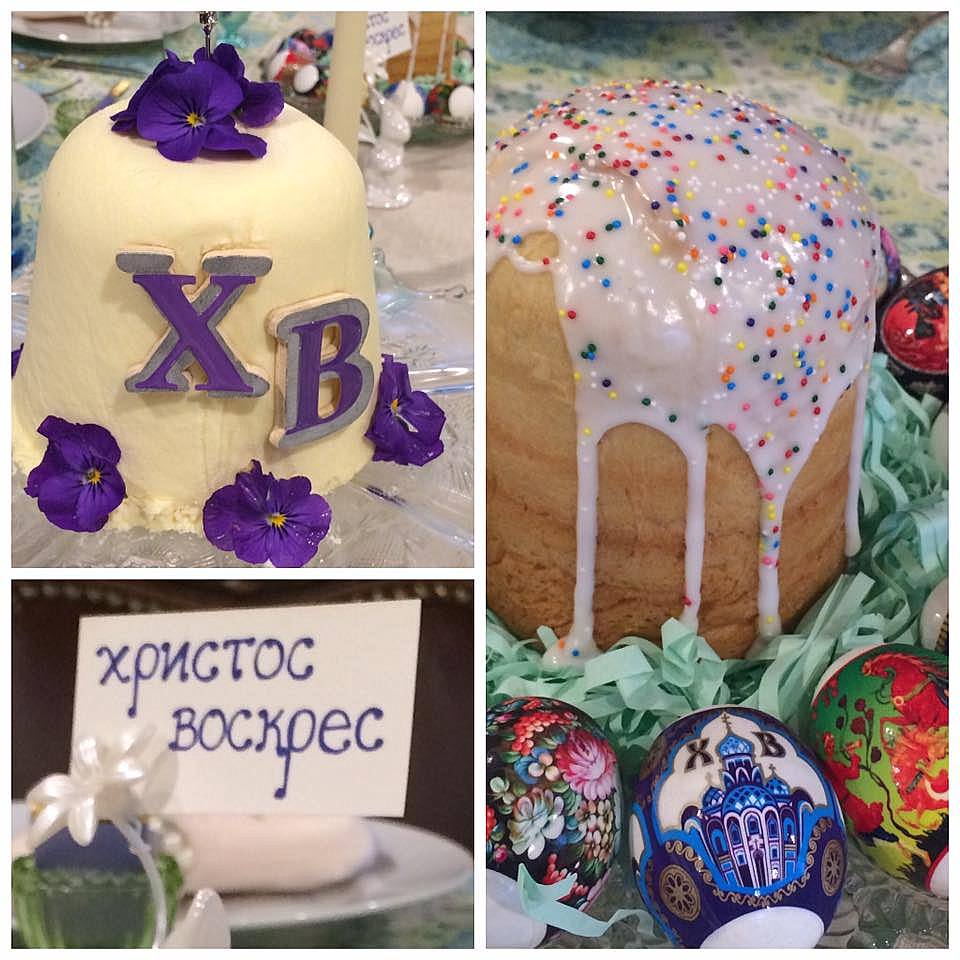
My mother makes Kulich (Russian Easter Bread) and Sernaya Paska (a yummy sweet cheese, cream spread) every Easter. The white pyramid looking thing with the cross on it is the Sernaya Paska. I don’t have a special mold so mine looks like a rounded dome. I’m including a recipe for the spread and a link to a recipe for Kulich. We eat the bread with the paska or slather it with sour-cream. My mom’s is the best and we’ve documented how she makes it and hopefully we’ll continue the tradition. You use empty, clean, 1 or 2 lb. coffee tins to bake the bread in.

Update for Easter 2008 ~ I’ll be adding my mother’s recipe for Kulich before Easter this year. Click here for the recipe.

Sernaya Paska

Ingredients:   18 – hard boiled eggs / 3 pounds Farmers cheese / 1 pint whipping cream / 3 cubes unsalted butter (12 oz.) / 3 cups sugar /

Press the Farmers cheese through a sieve. (This is the hardest part of the recipe) I usually use a wooden spoon and press it through a wire strainer a little at a time. Separate the egg yolks from the whites. (You will not be using the whites). Press the egg yolks through the sieve. Cream the sugar and butter together. Beat in the egg yolks. Beat in the cheese. Add whipping cream and mix well. You will place the mixture into a strainer lined with about 3 layers of cheesecloth. You will need enough cheesecloth to wrap up and over the top of the cheese. Place the cheese mixture into the cheese cloth lined strainer. Bring the ends of the cheese cloth up and tie the ends on top of the cheese in a knot. Place the sieve into a larger bowl suspended with enough room for the cheese to drain without sitting in the drained liquid. Place a plate on top of the cheese an place a heavy rock, brick, or other weight on top of the plate. Refrigerate over night.

Update #1: I used a plastic flower pot for my Seerney Paska and added more holes to the bottom. I got the shape I wanted and it drained well.

New tip: Use a potato ricer instead of a wire strainer for the egg yolks.

Update #2: This Sernaya Paska recipe is for a huge amount (enough for my huge extended family). If you just want a normal amount, cut the recipe in thirds. (6 cooked egg yolks, 1-lb. cheese, 2/3 cup whipping cream, 1 cube butter and 1 cup sugar. Enjoy!

Tip #2: If you don’t get around to baking Kulich you can substitute a good Panettone for the bread. Hard to find this time of year because most stores stock it at Christmas, not Easter. If you are fortunate to have a Italian food store near you they seem to stock it year round. I bought the most plain one I could find (not easy) It had raisens and candied orange and lemon bits in it. It was a good substitute nevertheless!

ht: Vera Titov/Nadia Bagdanov ~ recipe for Sernaya Paska

Spring has Sprung in Seattle

Restore your light, O excellent chief

to your country; for it is like spring

Where your countenance has appeared;

To the people the day passes more pleasantly,

And the sun shines more brightly.

Horace, Odes, bk. 4, 5, 5.

My first Spring blooms have appeared in my yard in Washington

This is my Lenten Rose~ Helleborus

2016-02-11 February plants and food2

Click on Lenten Rose (above) to learn more about this popular plant.

My friend Beth gave it to me for my birthday last year.

The amazing thing is that these plants are still alive.

This too is only by the grace of God.

 Spring clean-up 021

My Camellias which look so nice in a bowl with water and floating candles.

My Lilies that my friend Jan gave me won’t bloom for a bit.

Thank you ladies for adding a bit of your gardening pleasures to my brown thumb yard!

And thank you Lord for keeping these beauties alive. (The plants and my friends)

ht: quote , Real Christianity by William Wilberforce, rev./updated by Bob Beltz

My Testimony and a John Newton Hymn

HUME LAKE CHRISTIAN CAMP

Ellen’s simple version of her testimony, March 29th, 2007

I accepted Christ (was spiritually born) in the summer of 1963 at Hume Lake Christian Camp. I was a reluctant, stubborn, proud, follower of Jesus for many years. Similar to the birth process, I was comfortable in the womb (when God was calling me), but at birth when I had to get up and walk down an aisle and be singled out I howled like a baby. (Why do they say down the aisle instead of up the aisle?) I thank God He didn’t throw me back! I was a colicky baby. I fussed when anyone called attention to my bad attitudes, stubbornness, sin. I became more of a pharisee than a lover of God and my neighbor. I had my moments of obedience and peace. I had a long way to go and still do in the sanctification process. It has dawned on me what an amazing thing Christ did for me and the dirty rotten sinner I am. I still need to go deeper in this reality. I’m so glad God keeps after me. If my memory serves me correctly I cooperated more in the sanctification process after my baptism in high school. I’ve had periods of growth and periods of “being asleep in my faith”. BUT – GOD IS FAITHFUL and His promises are true. I want to follow Him for the rest of my life. Every day I want to say, thank you for saving me, I’m yours Lord. Every day I want to seek Him. More and more, I’m looking forward to seeing Him “face to face”.

I read this classic hymn by John Newton (In Evil Long I Took Delight) in Living the Cross Centered Life by C.J. Mahaney and felt it appropriate to include with my testimony.

In evil long I took delight
Unawed by shame or fear;
Till a new object struck my sight
And stopped my wild career.
I saw one hanging on a tree
In agonies and blood;
Who fixed his languid eyes on me
As near his cross I stood.
Sure never till my latest breath
Can I forget that look;
It seemed to charge me with his death
Though not a word he spoke.
My conscience felt and owned the guilt
And plunged me in despair;
I saw my sins his blood had spilt
And helped to nail him there.
Alas, I knew now what I did
But now my tears are vain;
Where shall my trembling soul be hid?
For I the Lord have slain.
A second look he gave which said
“I freely all forgive;
This blood is for thy ransom paid
I died that thou mayest live.”
Thus while his death my sin displays
In all its blackest hue;
Such is the mystery of grace,
It seals my pardon too.
With pleasing grief and mournful joy
My spirit now is filled;
That I should such a life destroy
Yet live by him I killed.

Olney Hymns, Book 2: On Occasional Subjects (London: W. Oliver, 1779).

Molokan Cemetery


By HUGO MARTIN
TIMES STAFF WRITER

Photos by AL SEIB / Los Angeles Times
Women in traditional dresses wander through the Russian Molokan Cemetery after attending the funeral of an elderly church member.
Danny Kanavalov and son Josh, of Bakersfield, walk through the graves at the Russian Molokan Cemetery in the City of Commerce.
EIGHTY-FOUR-YEAR-OLD Shasha Tolmachoff lives in Glendale, Ariz., but plans that when she dies, she will be buried in the City of Commerce, in the same dusty parcel where generations of Russian Molokans including her parents and in-laws have been laid to rest.
“It’s very comforting to be with them,” said the retired homemaker as she walked gingerly around the tightly packed tombstones at the Russian Molokan Cemetery on Slauson Avenue after attending the funeral of an elderly church member.
Tolmachoff is a member of a little-known Christian sect that broke away from the Russian Orthodox Church in the 1600s. About 60% of America’s church-going Molokans–about 3,000 people–live in Los Angeles. [Descendants of Molokans in LA County number over 20,000]. Molokan Since 1941, most of them have been burying their ancestors at the Slauson cemetery, sandwiched between a paper factory and a warehouse.
The 14-acre graveyard has about 2,500 graves and space for thousands more, free to dues-paying church members. Two smaller Molokan cemeteries in East Los Angeles are too small or too full to absorb many more graves.
In recent years, as commercial development has surrounded the Slauson cemetery and vacant land in Commerce has become scarce, banks and real estate firms have clamored to buy and develop the cemetery or its vacant 10 acres for nearly a half-million dollars an acre.
But the six Molokan churches that own the property have rejected all offers outright.
“If our people have put our blood, sweat and tears into this land, why move?” said Alex Goosseff”

Yesterday I posted a description of the Molokan religion.  I was raised in this community. My grandparents and other relatives are buried at this cemetery. In high school I chose to leave this religion because of some of their beliefs. The outfits you see on these ladies are what is worn by married women to church services, weddings, and funerals. Molokans wear pastels or white garments for their gatherings. No black or bright colors.

Molokans (Milk Drinkers)


 The following post on Molokans is a combination of material I copied from The Molokan Homepage, Wikipedia, and my own observations and additions about my families experience in the Molokan Church. I am italicizing my entries. This is a long post so I will shorten what appears on the post page and give you the option to continue reading more if you’d like. I’m organizing this material so my children and I have a better understanding of the history of Molokans and what we were brought out of by the grace of God. Tomorrow I’m posting an LA Times article on the Molokan Cemetery where my paternal grandparents and other relatives are buried.

 The Molokans (Russian: Молока́не) are a “Biblically-based” religious movement, among Russian peasants (serfs), who broke away from the Russian Orthodox Church in the 1550s. Molokans denied the Czar’s divine right to rule and rejected icons, Orthodox fasts, military service, the eating of unclean foods, and other practices, including water baptism. They also rejected the traditional beliefs (held by Roman Catholic, Protestant, and Orthodox Christians) in the Trinity, the veneration of religious icons, worship in cathedrals, the adherence toward saintly holidays, and the decisions of Synods and Ecumenical Councils.

 The Molokans also called “milk drinkers” were persecuted by their countrymen and government, and were exiled to a remote area of Russia (Transcaucasia), where they lived and prospered for several generations. In 1833, there was a reported outpouring of the Holy Spirit upon a number of Molokans in the Transcaucasus region. This created a schism between Constants and the newly evolved Jumpers and Leapers. With what the Molokans believed to be an additional manifestation of the Holy Spirit, this new smaller sect began a revival with intense zeal and reported miracles that purportedly rivaled that of Christ’s Apostles. Condemnation from the Constant sect lead to betrayals and imprisonment for many of the Jumpers and Leapers, now called New Israelites by their anointed leader Maxim Rudometkin. Maxim Rudometkin, while he was in prison, wrote a spiritual book that was smuggled out by close friends and relatives who came to visit him that later become the basis for a sub-sect of the Molokan faith. This book, used as a companion to the Holy Bible, is known as the Book of Spirit and Life. Molokans who accepted this book and who followed Maxim’s interpretations of the Bible are known as Maximisti, which make up most of the Jumper and Leapers sect. (This was the group my family was a part of. Maxim classified them as the New Israelites, the new chosen ones). (more…)

Be Beautiful

I decided to respond to the “Carnival of Beauty” challenge to post something on “The Beauty of Being Made in the Image of God”.  I ran to several good sources I know. The first excerpts come from R.C. Sproul in his book, Now That’s a Good Question, and a couple articles in His Tabletalk Magazine. The last contribution comes from my brother’s blog, The Temple.

R.C. Sproul – Now That’s a Good Question

The basic call to a person in this world is to be a reflection of the character of God. That’s what it means to be created in the Image of God. Long before the Sermon on the Mount, God required the people of Israel to reflect his character when he said to them, “Be holy even as I am holy.” He set them apart to be holy ones. The New Testament word for that is saints.

From Tabletalk June 2003 – Imago Dei – Sproul

An image cannot reflect something utterly dissimilar to it. Rather, an image is a likeness of something beyond itself. It is not the original, but it mirrors the original.

…That we bear the image of the God of glory is an unspeakable blessing. But with this elevated status comes a weighty responsibility. We were made to glorify God – to reflect the character of God and that duty comes with a divine mandate “You shall be holy, for I The Lord your God am holy” (Lev. 19:2)

” Thinking God’s Thoughts”  – Wayne Kenyon

Among created things, human beings are unique, for they are made in the image of God. As rational creatures, we are able to know God and , in a finite manner, think like Him.

For this reason, we have the great privilege of thinking God’s thoughts after Him. Also, as volitional creatures, we are able to reflect His excellencies in the manner in which we live and exercise dominion. This is our great responsibility.

…All of creation is also “for him”. With man’s great privilege to think God’s thoughts after Him comes the responsibility to take that which we receive and give it back to God in an act of worship. The God who is knowledge is worshipped by our knowing Him. The pursuit of knowledge is good. The only wise God is worshipped when His creatures are wise. This is done when we have the noblest of ends (i.e.,God Himself) and employ the most effective means of exercising dominion over His world. The God who is love is glorified when appreciative love for God is the motive from which we act. The God who is truth is worshipped when we “practice the truth” (I John: 1:6). God is worshipped when we model our lives after Him in loving obedience.

Finally from Steve at The Temple, a post on holiness. I’m including this because it personalizes holiness so well for me. Is what I’m doing the beautiful thing, the holy thing? Am I reflecting God’s image in me? Now in Steve’s words:

I wrote this in my journal some time ago:

“Holiness is doing something beautiful as opposed to not doing something ugly.”

I chose the words beautiful and ugly purposefully because they are not usually used in conjunction with holy behavior, and yet I think that they are wholly appropriate, and challenging. We are much more attracted to behaving beautifully, which may be defined as the most good. Beautiful is related to a word much closer to holiness: beatific. Being holy, being a holder of beauty. I like that correlation, it is an inspirational definition.

This perspective also hits the core issue in successful Christian living. What God wants from us is not simply the absence of evil acts, not even that we stop wanting to do bad things. God wants us to love to do the beautiful thing, the holy thing, the right thing. With regard to our speech, that is also the goal. So many of us, self included, have seen it as a matter of Christian freedom to use an occasional “strong” term, that was ultimately ugly. I am striving now to have only things of beauty as my expression in life, to the glory of the Beautiful One.

Be beautiful.

ht: Tabletalk from Ligonier Ministries and R.C. Sproul – June 2003

Come, Holy Spirit, heav’nly Dove

From Jan Karon’s, Light from Heaven:


Come, Holy Spirit, heav’nly Dove

With all thy quick’ning powers

Kindle a flame of sacred love

In these cold hearts of ours.

See how we trifle here below

Fond of these earthly toys

Our souls, how heavily they go

To reach eternal joys.

In vain we tune our formal songs

In vain we strive to rise

Hosannas languish on our tongue

And our devotion dies.

Come, Holy Spirit, heav’nly Dove

With all thy quick’ning powers

Come, shed abroad a Savior’s love

And that shall kindle ours.


Walking Song

Today the girls and I will be dodging Nazgul cyclists while we walk our trail. Look! I think that’s the Trinity tree! “There and back again” is 6 miles for us.

From J.R.R. Tolkien’s Lord of the Rings

Upon the hearth the fire is red,
Beneath the roof there is a bed;
But not yet weary are our feet,
Still round the corner we may meet

A sudden tree or standing stone
That none have seen but we alone.
Tree and flower and leaf and grass,
Let them pass! Let them pass!

Hill and water under sky
Pass them by! Pass them by!
Still round the corner there may wait
A new road or a secret gate,

And though we pass them by today,
Tomorrow we may come this way
And take the hidden paths that run
Towards the Moon or to the Sun.

Apple, thorn, and nut and sloe,
Let them go! Let them go!
Sand and stone and pool and dell,
Fare you well! Fare you well!

Home is behind, the world ahead,
And there are many paths to tread
Through shadows to the edge of night,
Until the stars are all alight.

Then world behind and home ahead,
We’ll wander back to home and bed.
Mist and twilight, cloud and shade,
Away shall fade! Away shall fade!

Fire and lamp and meat and bread,
And then to bed! And then to bed!

Marks of the True Christian


Romans 12:9-21 (ESV)

Let love be genuine. Abhor what is evil; hold fast to what is good. Love one another with brotherly affection. Outdo one another in showing honor. Do not be slothful in zeal, be fervent in spirit, serve the Lord. Rejoice in hope, be patient in tribulation, be constant in prayer. Contribute to the needs of the saints and seek to show hospitality.

Bless those who persecute you; bless and do not curse them. Rejoice with those who rejoice, weep with those who weep. Live in harmony with one another. Do not be haughty, but associate with the lowly. Never be conceited. Repay no one evil for evil, but give thought to do what is honorable in the sight of all. If possible, so far as it depends on you, live peaceably with all. Beloved, never avenge yourselves, but leave it to the wrath of God, for it is written, “Vengeance is mine, I will repay, says the Lord.” To the contrary, “if your enemy is hungry, feed him; if he is thirsty, give him something to drink; for by so doing you will heap burning coals on his head.” Do not be overcome by evil, but overcome evil with good.

I’m Amazed at this passage and how packed it is with practical Christianity. Wow! Blessings!

ht: http://www.scrollpublishing.com/store/media/Bible.jpg

Spring Reading Challenge


I’m joining the fray over at Callapidder Days  for the Spring Reading Challenge. Here’s my list of books I’d like to read/re-read.

Clouds of Witness  by Dorothy L. Sayers,  “One of the greatest mystery story writers of this century.”-L.A. Times   

The Screwtape Letters  by C.S. Lewis,   “My dear Wormwood,…”

The Treasure Principle  by Randy Alcorn,  “This book is about the joy of giving”

When People are Big and God is Small by Edward T. Welch,   (Overcoming Peer Pressure, Codependency, and the Fear of Man)

Byzantium by Stephen Lawhead,  An Irish Monk, Aidan, accompanies a gift, the Book of Kells to Byzantium. (Fantasy)

Oops! I forgot I’ll need to read Harry Potter and the Half Blood Prince by J.K. Rowling so I’m ready for book #7.

Just for the record I’m finishing Practical Christianity by William Wilberforce, and Living the Cross Centered Life by C.J. Mahaney before I move on to the rest.

Update: You can find my book reviews here;

https://happywonderer.wordpress.com/2007/04/04/spring-reading-challenge-book-reviews/

https://happywonderer.wordpress.com/2007/04/11/spring-reading-challenge-book-reviews-2/

https://happywonderer.wordpress.com/2007/05/08/book-reviews-byzantium-and-the-treasure-principle/

Let the reading continue!   LNB