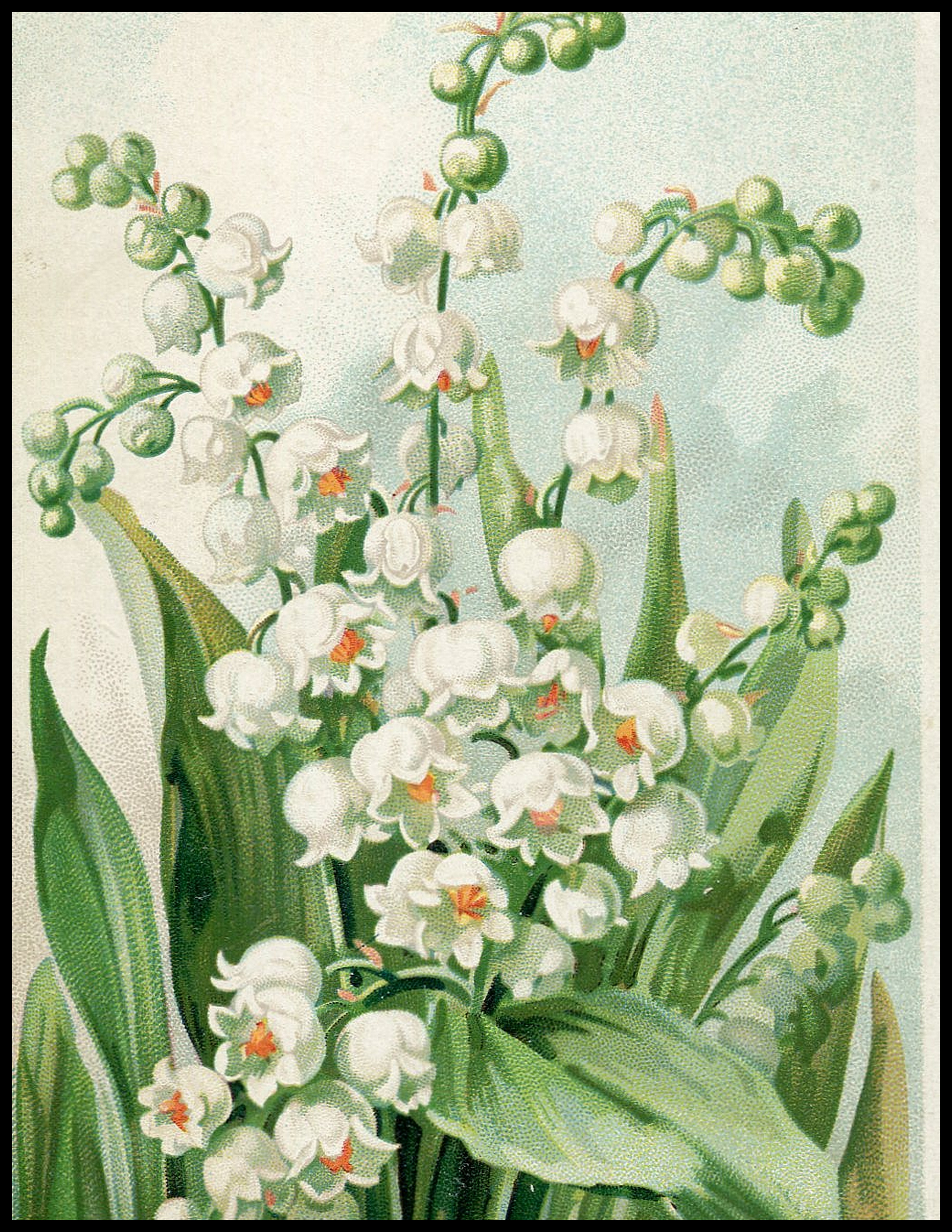
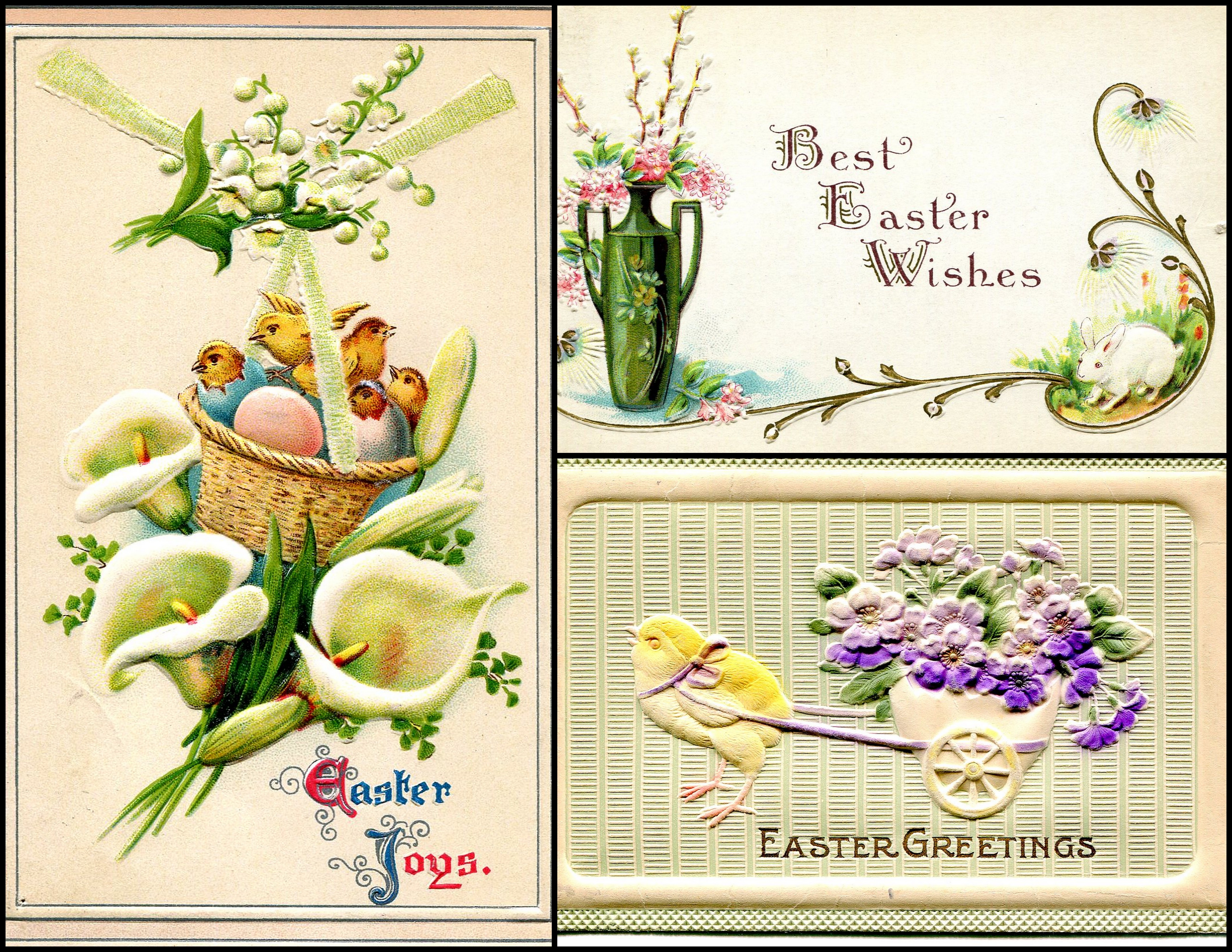
All of these postcards are from 1909-1915 and were sent to Dear’s Great, great, Aunt Emma during those years.

A Happy Easter ~ May He who rose this Easter morn Descend in Love and keep and bless thee.
For more TT click here.
A Happy Easter ~ May He who rose this Easter morn Descend in Love and keep and bless thee.
For more TT click here.
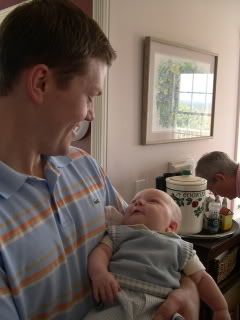
This is our oldest son Josh. Ask any of his friends with children and they’ll tell you that children and babies love Josh. Some people have even called him the “Baby Whisperer”. This picture was taken on Easter. Some children when being disciplined at home have been said to look at a Christmas greeting photo of Josh on the refrigerator and say ” I want Josh”.
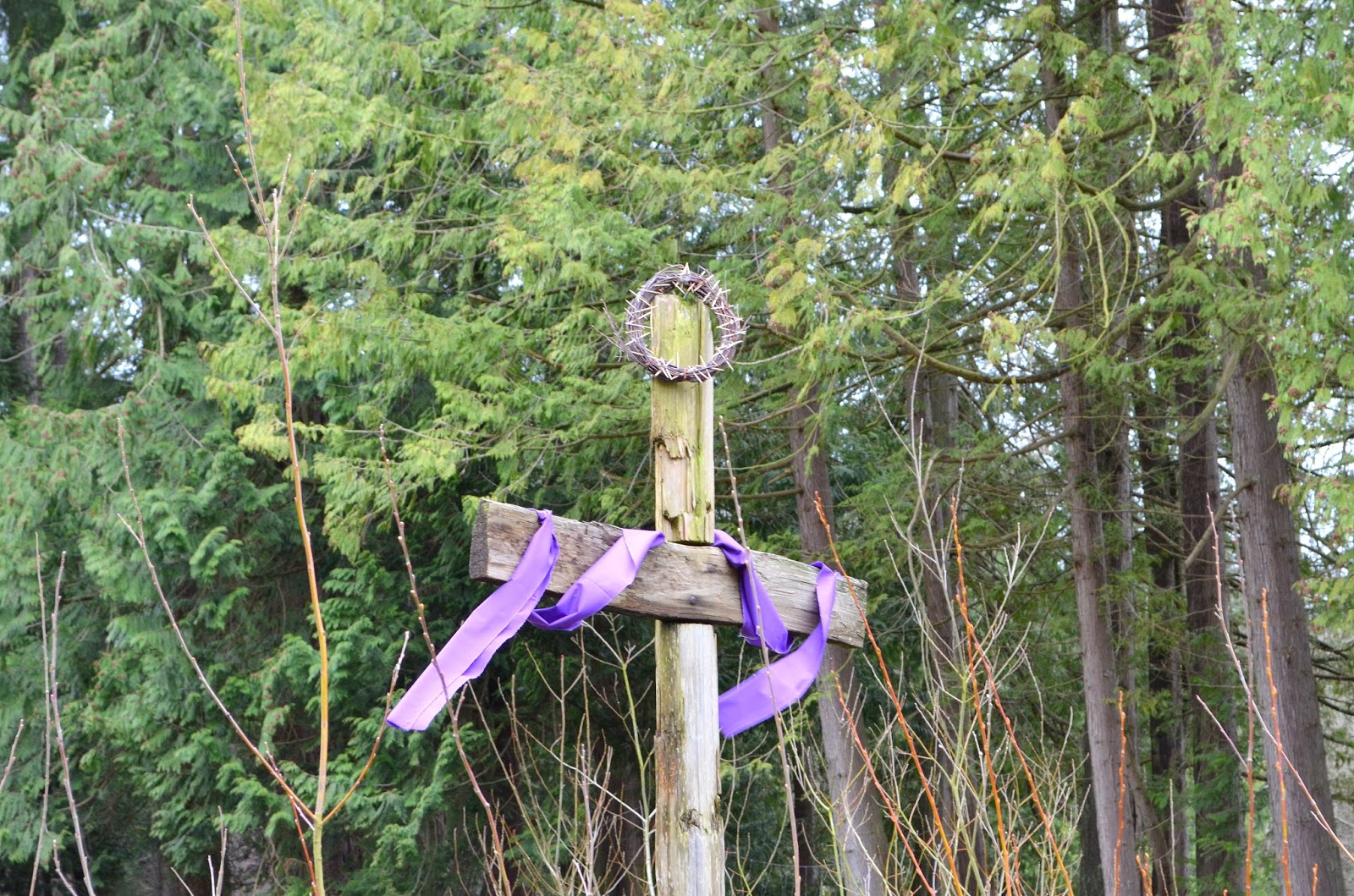
Christ Is Risen!
Truly He is Risen!
Khristos voskrese! Voistinu voskrese!
Blessings to all on this Glorious Easter Day!
One of my favorite Easter hymns growing up was Low in the Grave He lay. You just have to hear it sung in a church full of Russian Baptists! (In Russian of course) This song is sung with emotion and joy that can’t be missed.
Low in the Grave He Lay
Low in the grave He lay, Jesus my Savior,
Waiting the coming day, Jesus my Lord!
Refrain
Up from the grave He arose,
With a mighty triumph o’er His foes,
He arose a Victor from the dark domain,
And He lives forever, with His saints to reign.
He arose! He arose!
Hallelujah! Christ arose!
Vainly they watch His bed, Jesus my Savior;
Vainly they seal the dead, Jesus my Lord!
Refrain
Death cannot keep its Prey, Jesus my Savior;
He tore the bars away, Jesus my Lord!
Up from the grave He arose,
With a mighty triumph o’er His foes,
He arose a Victor from the dark domain,
And He lives forever, with His saints to reign.
He arose! He arose!
Hallelujah! Christ arose!
Words & Music: Robert Lowry, 1874.
Just for fun if you’d like to see Easter greetings from around the world, link to this site;
http://www.monachos.net/library/Paschal_Greeting
My brother in law sent this out yesterday and I thought it would be fun to share!
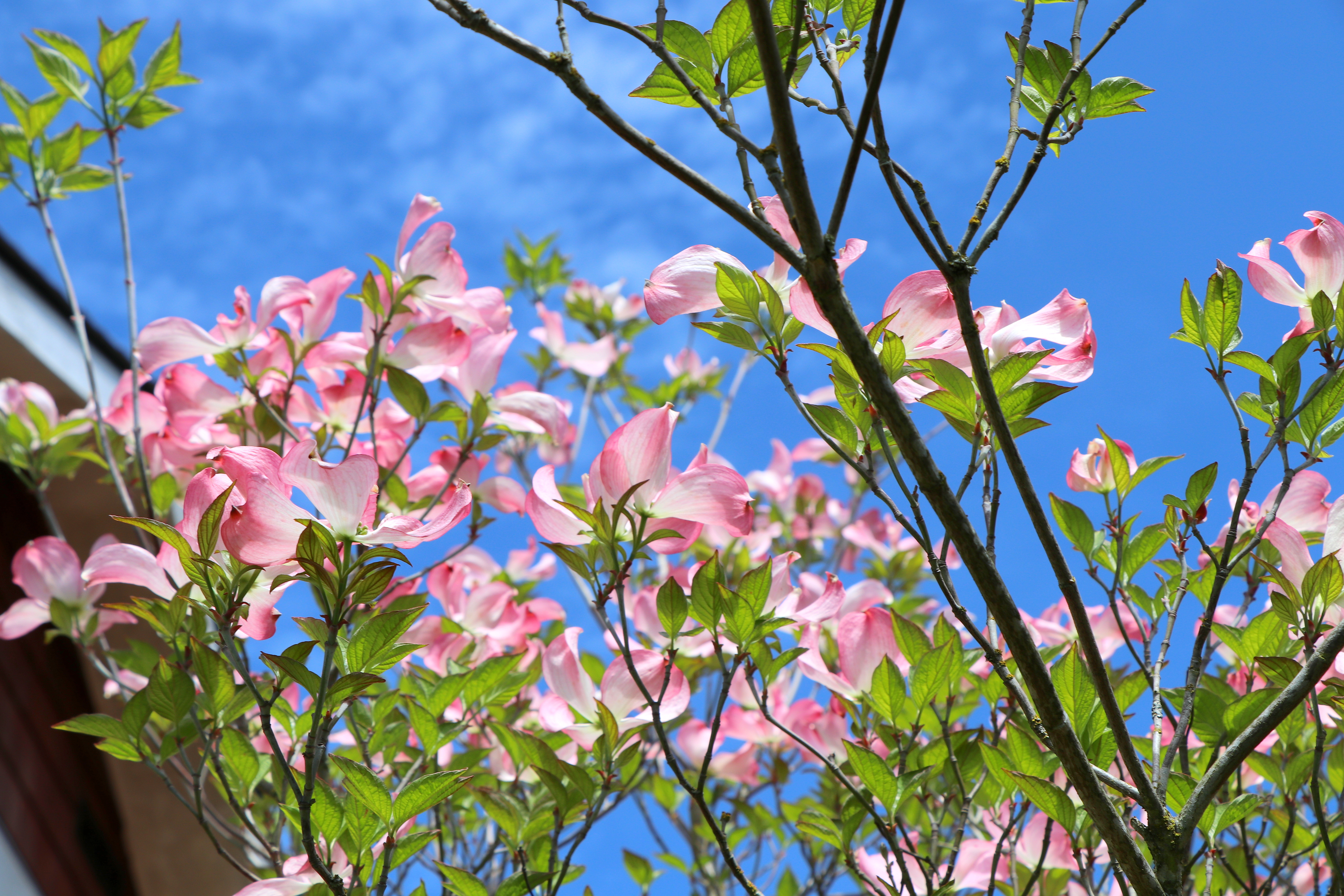
This excerpt is taken from Christianity Today (April 2000), written by Virginia Stem Owens;
Although it has not happened since 1913, and won’t happen again till 2008, Easter can come as early as March 23, just barely inside the official limits of spring. But whether Holy Week falls in March or April makes little difference in Texas. It’s always springtime here by then.
People like the dogwood to be in full bloom for Good Friday. They like to point out to one another how the dogwood’s white blossom, shaped like an ivory Maltese cross, each point dented and tinged with red, is an emblem of Christ’s crucifixion wounds. They even send one another greeting cards bearing the so-called Legend of the Dogwood, which links the tree with the wood used for the cross.
The dogwood trees are usually blooming at about the same time I teach college sophomores the Housman poem that begins,
Loveliest of trees, the cherry now
Is hung with bloom along the bough,
And stands about the woodland ride
Wearing white for Eastertide.Most of my students have never seen cherry trees in bloom. The Texas weather is too mild and genial for the cherry’s hearty nature, so I rely on the dogwood tree to furnish them with a reasonable facsimile of Housman’s vision. The decorative dogwood chooses to display its white blossoms along the highways precisely when they will be the most conspicuous—before their own leaves unfurl and before the other, taller trees have put on their new leaves. Thus, the shadowy recesses of the winter-bare forests provide the perfect background for the white blossoms.”
The Legend of the Dogwood
There is a legend, that at the time of the Crucifixion the dogwood had been the size of the oak and other forest trees. So firm and strong was the tree that it was chosen as the timber of the cross. To be used thus for such a cruel purpose greatly distressed the tree, and Jesus, nailed upon it, sensed this, and in His gentle pity for all sorrow and suffering said to it: “Because of your regret and pity for My suffering, never again shall the dogwood tree grow large enough to be used as a cross. Henceforth it shall be slender and bent and twisted and its blossoms shall be in the form of a cross. ..two long and two short petals. And in the center of the outer edge of each petal there will be nail prints, brown with rust and stained with red, and in the center of the flower will be a crown of thorns, and all who see it will remember.”
I recognize that this is just a legend but I wanted to post these two entries because I’ve always loved the Dogwood blooms. If I look at them and think about what my Savior did for me that’s a good thing. He created the tree, the beautiful bloom, and you and me to enjoy it!
http://www.ctlibrary.com/ct/2000/aprilweb-only/43.0b.html
http://www.midamericawoodcarvers.org/patterns/dogwood.htm
When they had approached Jerusalem and had come to Bethphage, at the Mount of Olives, then Jesus sent two disciples, saying to them, “Go into the village opposite you, and immediately you will find a donkey tied there and a colt with her; untie them and bring them to Me. “If anyone says anything to you, you shall say, ‘The Lord has need of them, ‘ and immediately he will send them.” This took place to fulfill what was spoken through the prophet: “SAY TO THE DAUGHTER OF ZION, ‘BEHOLD YOUR KING IS COMING TO YOU, GENTLE, AND MOUNTED ON A DONKEY, EVEN ON A COLT, THE FOAL OF A BEAST OF BURDEN.” The disciples went and did just as Jesus had instructed them, and brought the donkey and the colt, and laid their coats on them; and He sat on the coats. Most of the crowd spread their coats in the road, and others were cutting branches from the trees and spreading them in the road. The crowds going ahead of Him, and those who followed, were shouting, “Hosanna to the Son of David; BLESSED IS HE WHO COMES IN THE NAME OF THE LORD; HOSANNA IN THE HIGHEST!” When He had entered Jerusalem, all the city was stirred, saying, “Who is this?” And the crowds were saying, This is the prophet Jesus, from Nazareth in Galilee.”
Matthew 21: 1-11 (NASB)
All Glory, Laud and Honor
All glory, laud and honor,
To Thee, Redeemer, King,
To whom the lips of children
Made sweet hosannas ring.
Thou art the king of Israel,
Thou David’s royal Son,
Who in the Lord’s name comest,
The King and Blessèd One.
The company of angels
Are praising Thee on High,
And mortal men and all things
Created make reply.
The people of the Hebrews
With palms before Thee went;
Our prayer and praise and anthems
Before Thee we present.
To Thee, before Thy passion,
They sang their hymns of praise;
To Thee, now high exalted,
Our melody we raise.
Thou didst accept their praises;
Accept the prayers we bring,
Who in all good delightest,
Thou good and gracious King.
Thy sorrow and Thy triumph
Grant us, O Christ, to share,
That to the holy city
Together we may fare.
For homage may we bring Thee
Our victory o’er the foe,
That in the Conqueror’s triumph
This strain may ever flow.
Words: Theodulph of Orleans, circa 820, trans. John M. Neale
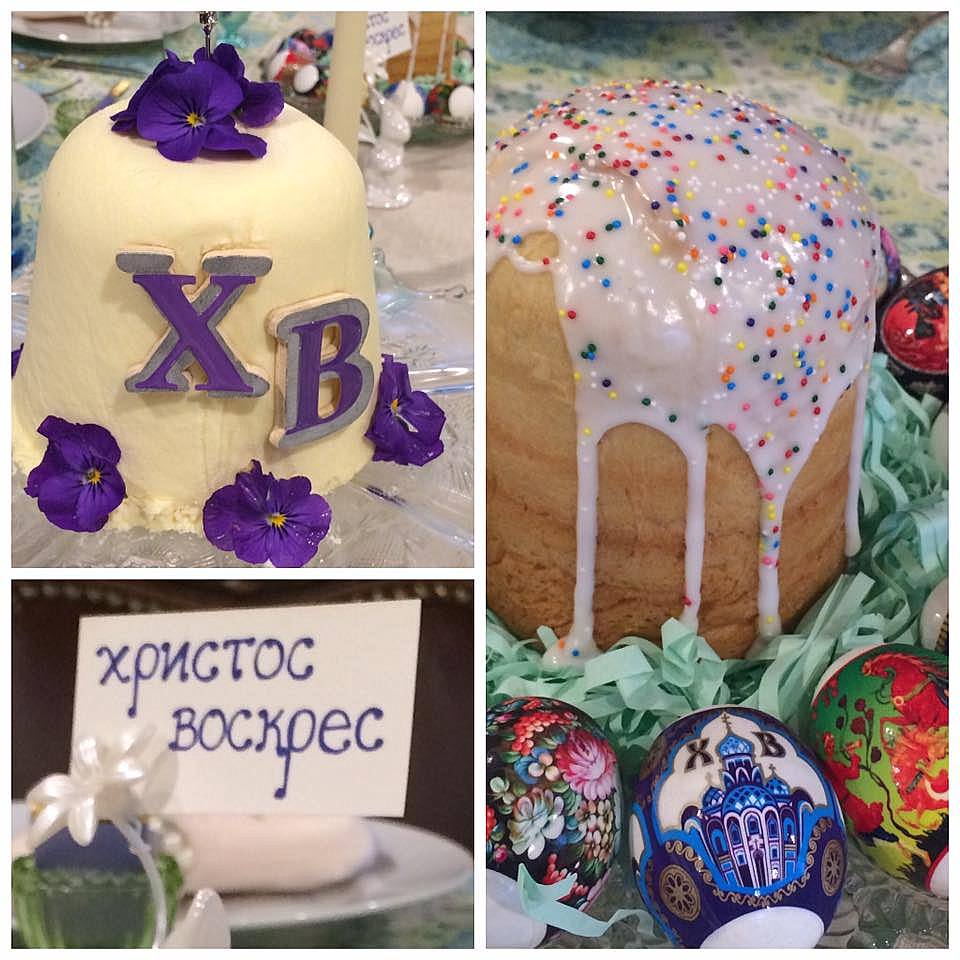 My mother makes Kulich (Russian Easter Bread) and Sernaya Paska (a yummy sweet cheese, cream spread) every Easter. The white pyramid looking thing with the cross on it is the Sernaya Paska. I don’t have a special mold so mine looks like a rounded dome. I’m including a recipe for the spread and a link to a recipe for Kulich. We eat the bread with the paska or slather it with sour-cream. My mom’s is the best and we’ve documented how she makes it and hopefully we’ll continue the tradition. You use empty, clean, 1 or 2 lb. coffee tins to bake the bread in.
Sernaya Paska
Ingredients: 18 – hard boiled eggs / 3 pounds Farmers cheese / 1 pint whipping cream / 3 cubes unsalted butter (12 oz.) / 3 cups sugar /
Press the Farmers cheese through a sieve. (This is the hardest part of the recipe) I usually use a wooden spoon and press it through a wire strainer a little at a time. Separate the egg yolks from the whites. (You will not be using the whites). Press the egg yolks through the sieve. Cream the sugar and butter together. Beat in the egg yolks. Beat in the cheese. Add whipping cream and mix well. You will place the mixture into a strainer lined with about 3 layers of cheesecloth. You will need enough cheesecloth to wrap up and over the top of the cheese. Place the cheese mixture into the cheese cloth lined strainer. Bring the ends of the cheese cloth up and tie the ends on top of the cheese in a knot. Place the sieve into a larger bowl suspended with enough room for the cheese to drain without sitting in the drained liquid. Place a plate on top of the cheese an place a heavy rock, brick, or other weight on top of the plate. Refrigerate over night.
Update #1: I used a plastic flower pot for my Seerney Paska and added more holes to the bottom. I got the shape I wanted and it drained well.
New tip: Use a potato ricer instead of a wire strainer for the egg yolks.
Update #2: This Sernaya Paska recipe is for a huge amount (enough for my huge extended family). If you just want a normal amount, cut the recipe in thirds. (6 cooked egg yolks, 1-lb. cheese, 2/3 cup whipping cream, 1 cube butter and 1 cup sugar. Enjoy!
Tip #2: If you don’t get around to baking Kulich you can substitute a good Panettone for the bread. Hard to find this time of year because most stores stock it at Christmas, not Easter. If you are fortunate to have a Italian food store near you they seem to stock it year round. I bought the most plain one I could find (not easy) It had raisens and candied orange and lemon bits in it. It was a good substitute nevertheless!
ht: Vera Titov/Nadia Bagdanov ~ recipe for Sernaya Paska
 The Happy Wonderer ~ ellen b.