InSPIREd Sunday

A simple offering this week during this very busy extended weekend. This church is in Camarillo, California where Dear and I lived for a short 4 year stint while he worked in Thousand Oaks. St. Mary Magdalen Church was kiddy corner to a restaurant that we enjoyed frequenting. In the future I will show you the stained glass windows that have a wonderful story behind them.

For those of you in the good ole U.S.A. I hope you had a wonderful Thanksgiving. Ours was fabulous and then we started our Christmas decorating. While in the thick of that I managed to break one of my little toes on my left foot and I’ve been moving very slowly around this old house. I’ve been able to keep doing a little here and there between keeping my foot elevated and rested. We got our first dusting of snow on Saturday!! This Sunday is the first Sunday of Advent. After church we are going to go purchase our Christmas mystery tree.

Enough of me…you can visit InSPIREd Sunday hosted by Beth and Sally and join in some sacred viewings around the world.

InSPIREd Sunday ~ Chicago

In May of 2012 I traveled with Dear to an Oncology Conference held in Chicago and on one of the mornings we had time to enjoy breakfast together and a visit to two interesting churches filled with history.

” Holy Name Cathedral on North State Street is both a Roman Catholic parish and the seat of the Archdiocese of Chicago. After the fire of 1871 destroyed the former Holy Name Church, Bishop Thomas Foley resolved to build a spectacular replacement. Brooklyn architect Patrick Charles Keely designed the Gothic structure, and the cornerstone was laid on July 19, 1874.”

Once inside the church, the most striking feature is the suspended Resurrection Crucifix sculpted by the artist Ivo Demetz.

“Among the many striking features inside the Cathedral are the five red, broad-brimmed, cardinals’ hats, or galeros, suspended from the ceiling. Traditionally, this symbol of a cardinal is raised to the ceiling of his cathedral upon his death. The hat hangs until it turns into dust, a reminder that all earthly glory is passing.”  You’ll need to look carefully in the upper part of my photo which is almost too dark to see the galeros.

The most famous story about Holy Name Cathedral involves a mobster gunfight that happened on Oct. 11, 1926. Gunmen hired by Al Capone were positioned across from the cathedral and killed Earl “Hymie” Weiss in a hail of gunfire, leaving a bullet wedged into the cornerstone. We saw the bullet hole but I didn’t take a photo of it.

The Fourth Presbyterian Church was the 2nd church we visited. “The name “Fourth” was selected not because it was the fourth Presbyterian church to be founded in Chicago—there had been several founded before then, with North Presbyterian being one of the earliest—but because “Fourth” was the lowest number then not in use. “ The first structure at a different location was re-dedicated on October 8, 1871 and just 2 hours after it’s evening services concluded the Great Chicago Fire swept through downtown and the Northside and destroyed it. They were at another location and then in 1912 they settled at this property on Michigan Ave.

There was no “Michigan Avenue” north of the Chicago River yet in 1912; it was to be several years before a bridge was constructed over the Chicago River to extend north the Michigan Avenue that had grown in prominence south of the river.

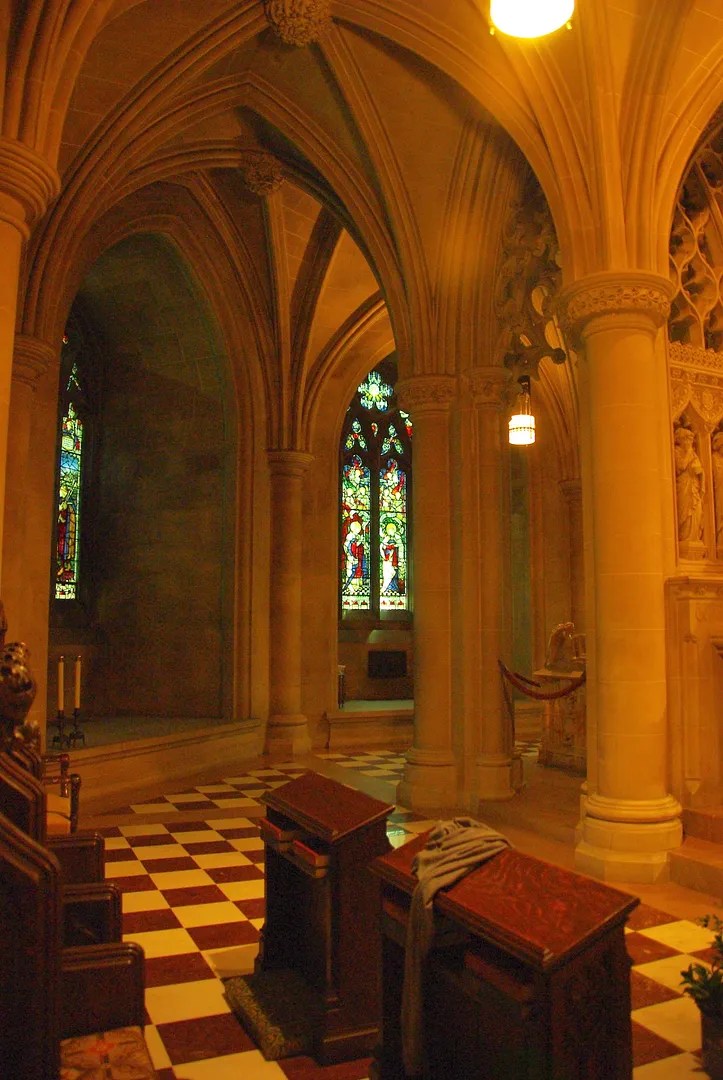
“The church proper (the Sanctuary) was designed by architect Ralph Adams Cram, the parish buildings around the courtyard by architect Howard Van Doren Shaw, and the stained glass windows by Charles J. Connick. The interior painting and decoration of the Sanctuary was overseen by Frederick Clay Bartlett. The new church was dedicated in 1914.”

“The North Michigan Avenue “Magnificent Mile” neighborhood literally grew up around the church, particularly after the opening of the Michigan Avenue Bridge in 1920. Except for the familiar Water Tower complex two blocks to the south, which survived the Chicago Fire of 1871, Fourth Church is now the oldest surviving structure on Michigan Avenue north of the river.”

The hotel we stayed in was just across the street from The Fourth Presbyterian Church. Do you make it a point to open the door of a beautiful church when you are traveling. I’m always happy to find them open to enjoy.

Linking up with InSPIREd Sunday with Beth and Sally.

Back here in November of 2014 we are still cold and dry in the greater Seattle area. Dear has been finishing up some painting of new doors and baseboard and touching up the walls around the bathroom renovation. We moved some wall art which meant some more touch up needed to be done. We’re getting ready for an early Thanksgiving gathering this coming weekend. How was your weekend?

St. John’s Seminary~Camarillo, California

Dear and I lived in Camarillo, California from 2006 until Spring of 2010 because of Dear’s work. Driving around Camarillo I noticed St. John’s Seminary set high on a hill. I tried to see if I could get on the grounds but it was a private property with a gated entrance that was locked up tight.

In December of 2008 I had the rare opportunity to visit the grounds of St. John’s Seminary for a Christmas Concert that a friend’s son was performing in.  When I found out the campus would be open for this concert I was there with bells on. The concert was beautifully performed in the historic chapel.

In 1924, plans were being made for a minor seminary for the training of priests in the Los Angeles Area. Sixty five students were registered for the academic year of 1926-27. At that time, Juan E. Camarillo made a gift to the archdiocese of 100 acres on the knoll of Rancho Calleguas, which land separated the Calleguas Ranch from Rancho Las Posas. The purpose of Mr. Camarillo’s gift was the location there of a major seminary. Ground was broken for St. John’s in March of 1938, after a speedy and successful drive for funds.

The original buildings, including the chapel which is unique in its marble decorations and stained-glass windows, are built around a quad with interior porticoes.

When Archbishop Cantwell was planning for the new seminary, he approached Mrs. Edward Laurence Doheny, Sr. about the possibility that she would donate the library. Mr. Doheny, her husband, the great oil tycoon, had passed away in 1935. Together they had built the library at USC in memory of Edward Laurence Doheny, Jr. and Mrs. Doheny considered this new opportunity a most appropriate way to honor the memory of her husband. It also afforded her the opportunity to create a permanent home for the thousands of rare books and art objects which she had collected since 1930 and which would burgeon before her death in 1958.

Mrs. Doheny hired her favorite architect, Wallace Neff, and commissioned him to design a building which would house a working library for the students and faculty as well as quarters for her collection.

The result is a classical Spanish building which reflects some of the overtones of the 1,100 years of Moorish influence in Spain. The pale pink stucco structure complements and enhances the neo-Spanish architecture of the main buildings.

It was a very bright sunny day when I visited. On some of the photos you can’t see the pink tone to the building but this photo that I took at this angle the pink shows through nicely.

The first floor of the library serves students and faculty, and the second floor housed the Estelle Doheny Collection which contained some 8,000 volumes of rare books. There were also displayed much of Mrs. Doheny’s fine French period furniture, canvases by Barbizon and western American artists. The collection was distinguished for an impressive array of Bibles which were significant type, among which the premier volume were one of the few extant original Gutenberg Bibles. I found out today her entire collection was sold off to over 40 different buyers from around the world in 1988! Oh how sad that this collection is scattered all over the world now.

I wasn’t aware that this significant collection had been housed in this library when I was on campus in December. After researching and finding this information I was disappointed to find out it was no longer there.

I found my experience on this day to be quite privileged. Experiencing the amazing architecture in person was so much better than my photos can afford.

I’m linking this post that I copied from a post I published in 2009 to InSPIREd Sunday.

Thank you Beth and Sally for hosting!

ABC Wednesday ~ Mary Magdalen Church, Camarillo

M is for St. Mary Magdalen Church in Camarillo, California

In my Sky Watch #10 Post I mentioned that I was trying to get inside St. Mary Magdalen Church in Camarillo to see their historic stained glass windows. A few Sundays ago we went to the church grounds to buy some home made Mexican food at a fiesta they were putting on as a fund raiser. While there I was thrilled to see the church doors open and I went inside and was able to finally see and take pictures of these amazing works of art.

Here is an excerpt written in a historical site about the windows.

“The most notable chapel fixtures were its magnificent 13 stained glass windows.  These azure, crimson, green, and gold windows tell a double story — one of the life of Christ, the other of a world at war.

While on a trip to Europe, Juan Camarillo selected the windows in Munich, Germany. The year was 1913 and the early rumbles of the continent gathering its strength for conflict were growing with each passing day. Somewhere between the studios of glass-blower F. X. Zettler of Munich and the church on a hilltop in faraway Camarillo, the stained glass windows were lost. Zettler’s name can be seen at the bottom of the windows depicting the Holy Family (east side) and Christ with the children (west side). Despite the best efforts of the Camarillo family through consuls and ambassadors, the windows appeared lost forever. Mrs. Carmen Camarillo Jones recalled that her uncle Juan feared they were at the bottom of the sea. One day a letter arrived from a German official. This official in Munich had been noticing several large crates staked outside a building with Juan’s name on them. He had written Juan several letters and finally one got through at the end of Word War 1. Much to the joy and relief of everyone, the lost windows had been found. However, it was a painfully slow and long trek to Los Angeles, and then on to Camarillo, before they were finally installed in the thick brick and plastered chapel walls in 1919.”

After I had been in the church for about 5 minutes the caretaker came in and closed the doors behind me I figured my time inside was over.

To see more of the outside of this historical church click here.

For more ABC posts on the letter M visit the ABC Blog.